Program
- Education Series
- Streaming
Tanakh Beyond Nationalism
The Hebrew Bible is one of the most argued-over texts in human history, and today is used to propagate some of the most pernicious agendas in the world. Rather than reading the Tanakh as a single voice delivering a settled message, this class will treat it as an ongoing conversation in which the terms of the covenant are renegotiated in every generation. Each session centers a pivotal moment where that relationship is updated, and notices that these stories always come with competing accounts of the moment, what the covenant was before, and competing visions of what it should become.

The Tanakh Beyond Nationalism: An 8 Week Course with Rabbi Andy Kahn
Wednesdays, 7:00–8:30 pm Eastern
June 3 – July 22; synchronous and asynchronous available
Drawing on the insights of modern scholars and an adaptation of the traditional Pardes method of interpretation, we will investigate these tensions together rather than resolve them. No background in Hebrew or biblical studies required.
Session Schedule
June 3 — What's the TaNaKh to Us? Before we can read the text, we have to ask what kind of object it is. We explore the Tanakh's different names and what each one implies, survey its contents and their strange ordering, and ask what it means to approach an ancient anthology as a living document.
June 10 — From Adam to Noah: The Shape of the Human The Bible opens with three creation stories, , and two flood accounts, and lots of disagreement. We trace the arc from Adam in the garden to the first universal covenant after the flood, and ask what God and humanity learn about each other along the way.
June 17 — The Patriarchs and Their Forgotten Children Abraham's covenant was meant for "all families of the earth." Within two generations it had narrowed to one son, one line, twelve tribes. We ask who decides what the covenant is for, and what its overarching purpose is.
June 24 — Moses, Joshua, and the Covenant After the Mountain What actually happened at Sinai? The Torah preserves at least three incompatible answers.
July 1 — Samuel, Saul, David, and the Covenant with a King The people ask for a king, then God calls it a betrayal, and immediately helps them pick one. We read the theologies of monarchy, and investigate how tradition sustains a promise that history seems to contradict.
July 8 — The Temple, the Mishkan, and Where God Lives For generations God lived in a portable tent, then Solomon built a permanent structure, and in his own dedication prayer admitted it couldn't contain God. We explore what is gained and lost when the divine presence gets a fixed address, and listen to the biblical voices that were never entirely sure it was a good idea.
July 15 — The Prophets and the Expanding Covenant The prophets argue about the purpose and enactment of the covenant. We read the prophetic challenge to Temple religion, Jeremiah's letter to the exiles, and Isaiah's vision of a house of prayer for all peoples.
July 22 — After the Exile: Two Visions of What Judaism Is After Babylon, new Judaisms emerge: A return to the land from Babylonia, and a Diasporic presence throughout the region. The Hebrew Bible ends, in its Jewish ordering, with a Persian king announcing the covenant's restoration. We ask: where does the covenant end? And has it?
Related Programming
- Education Series
- Streaming
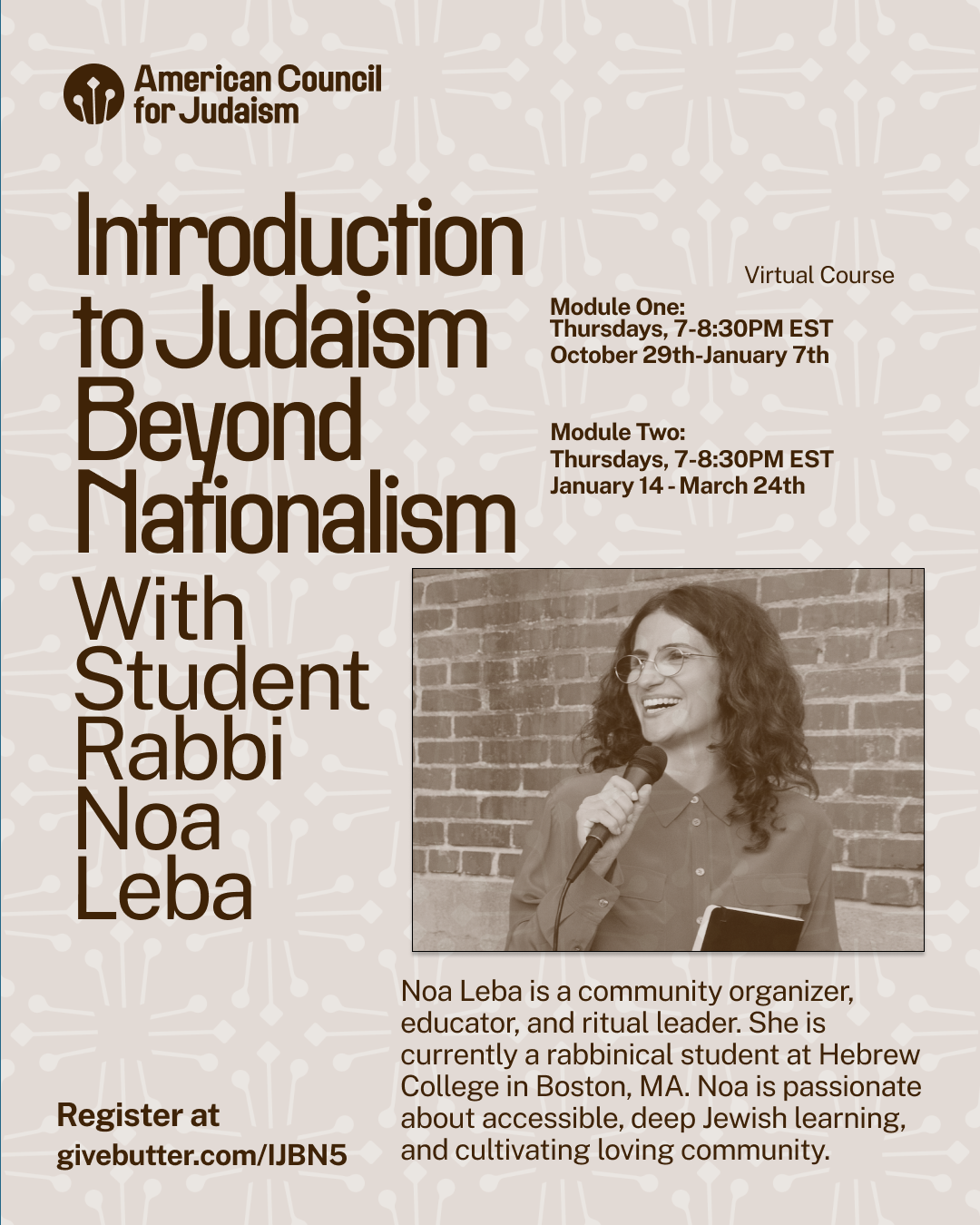
Introduction to Judaism Beyond Nationalism with Student Rabbi Noa Leba
Introduction to Judaism Beyond Nationalism is a broad-stroke survey of Jewish life, culture, belief and non-belief, and the major ideas that have shaped Jews and Judaism across time. The course offers participants a grounding in the practices, philosophies, and expressions of Jewish life from the ancient world to the present.
Learn More
- Education Series
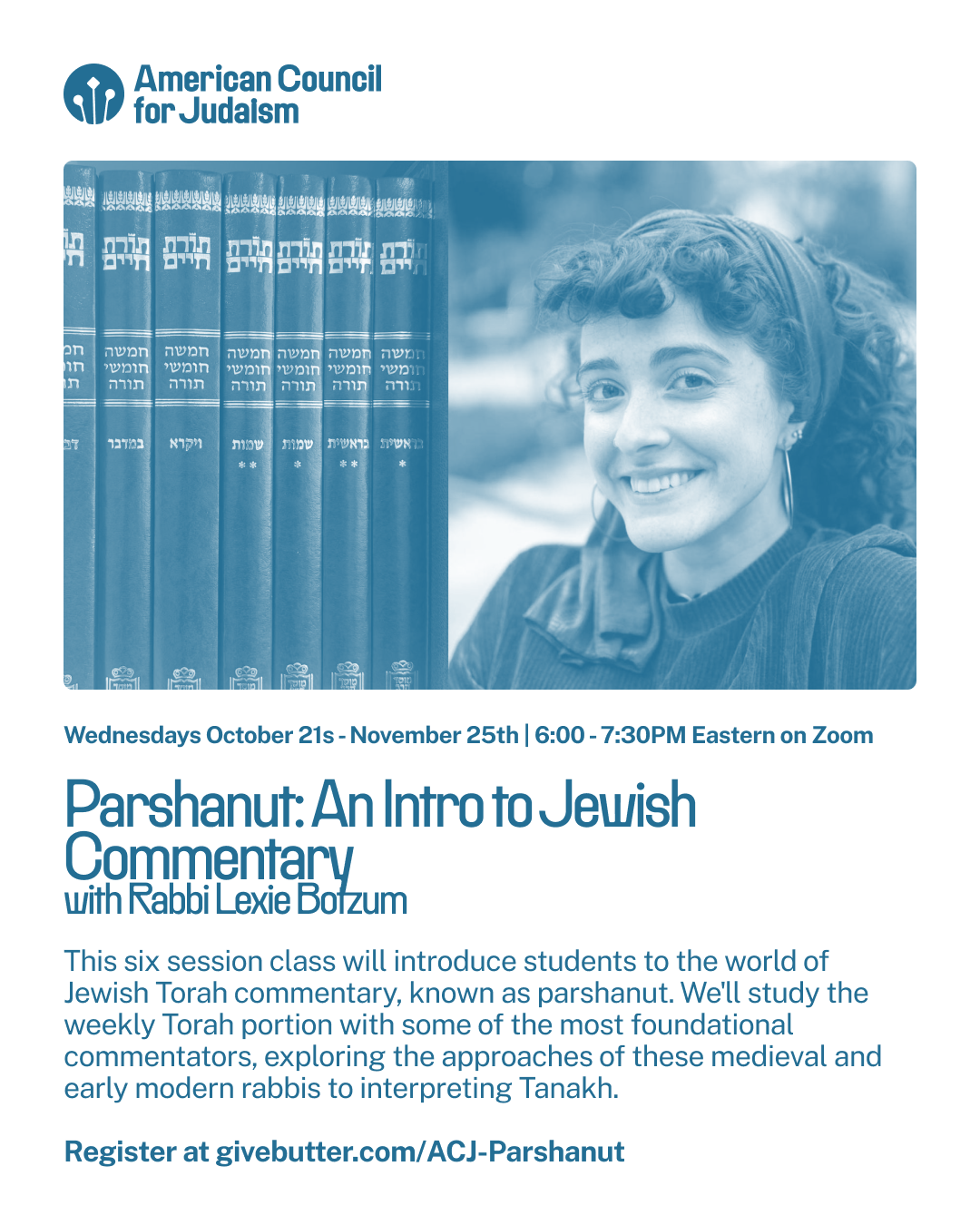
Parshanut: An Intro to Jewish Commentary
Parshanut: An Intro to Jewish Commentary
Wednesdays at 6:00-7:30 PM EST October 21st - November 25th
This six session class will introduce students to the world of Jewish Torah commentary, known as parshanut. We'll study the weekly Torah portion with some of the most foundational commentators, exploring the approaches of these medieval and early modern rabbis to interpreting Tanakh.
Learn More
- Education Series
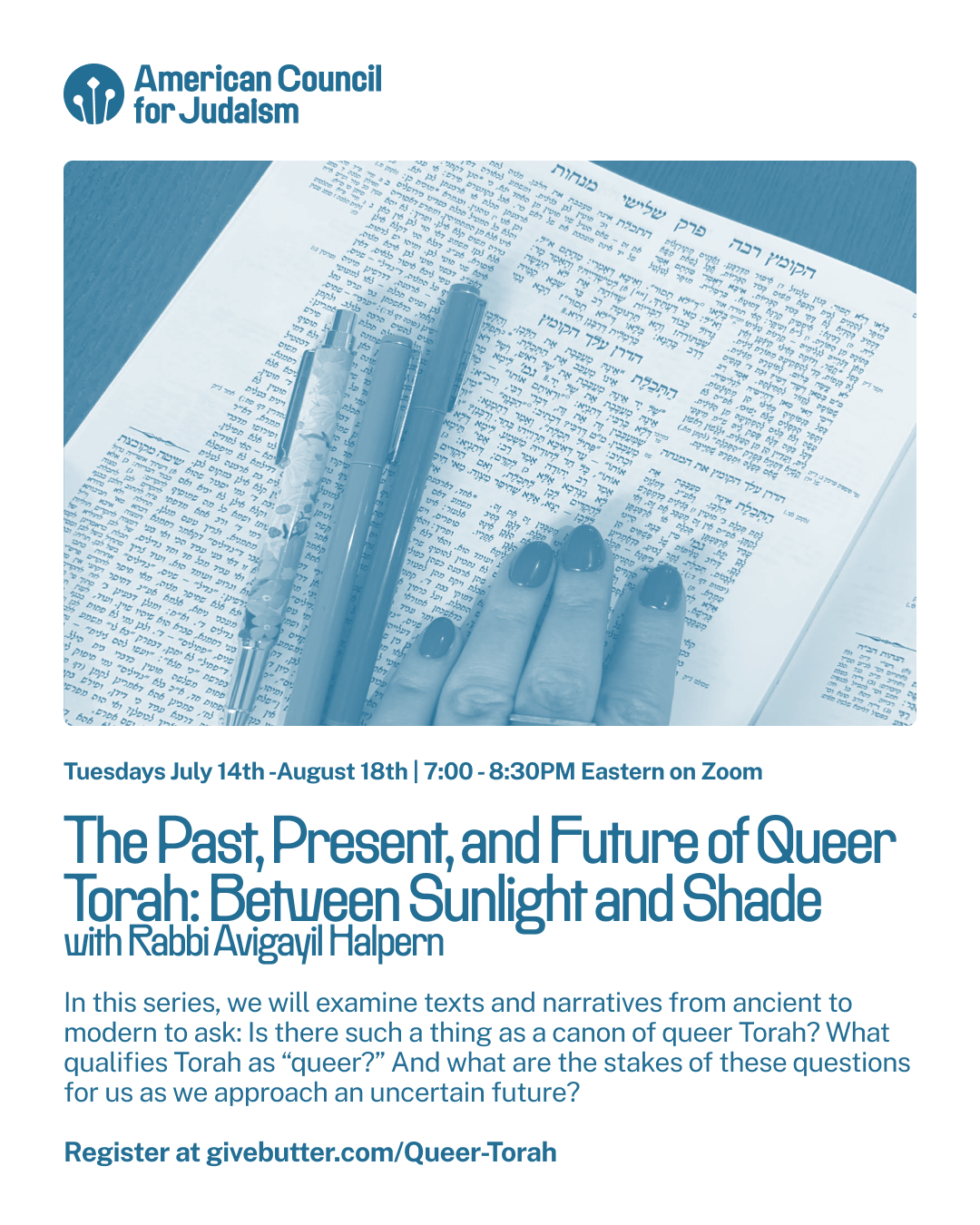
The Past, Present, and Future of Queer Torah: Between Sunlight and Shade With Rabbi Avigayil Halpern
This class takes its name from the Rabbinic sage Rabbi Yochanan, who is often read as queer – his beauty is described as that of a silver goblet filled with pomegranate seeds and crowned with roses, set between sun and shade. It is in the beauty of that middle space that queer Torah emerges. In this series, we will examine texts and narratives from ancient to modern to ask: Is there such a thing as a canon of queer Torah? What qualifies Torah as “queer?” And what are the stakes of these questions for us as we approach an uncertain future?
Learn More