Program
- Education Series
- Streaming
Introduction to Judaism Beyond Nationalism Cohort 3
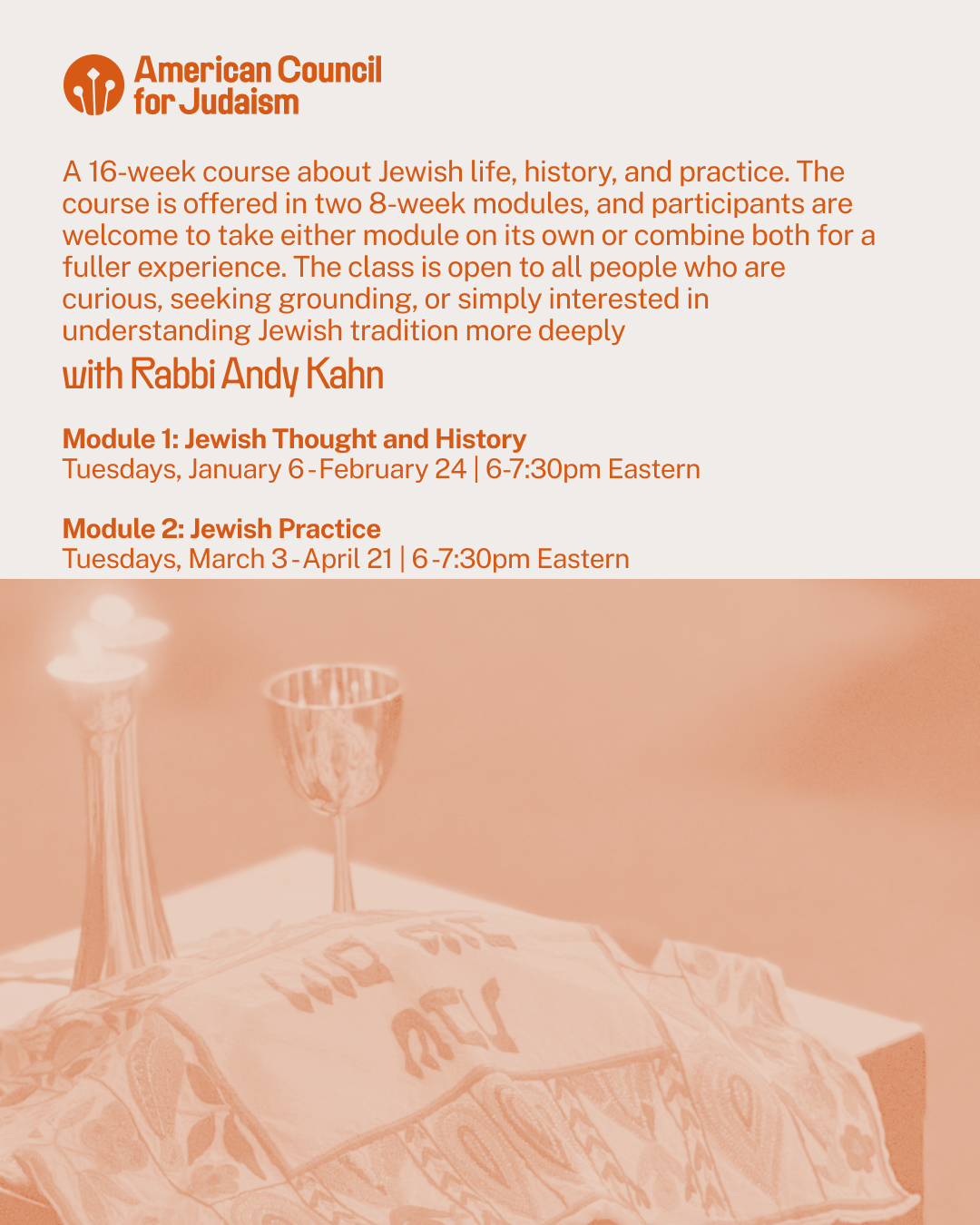
Introduction to Judaism Beyond Nationalism is a broad-stroke survey of Jewish life, culture, belief and non-belief, and the major ideas that have shaped Jews and Judaism across time. The course offers participants a grounding in the practices, philosophies, and expressions of Jewish life from the ancient world to the present.
The course is divided into two 8-week modules. A third module, focused on personal Jewish development and practice-building, will be offered after the conclusion of Module 2.
Recordings will be provided for anyone who cannot attend live. We encourage regular participation, while recognizing that life happens. The course pairs well with either Judaisms by Aaron Hahn Tapper or Jewish History: A Very Short Introduction by David Meyer.
Course Pricing
-
Module One: $300
-
Module Two: $300
-
Modules One & Two Together: $550
-
Scholarships available by application
Module 1: History and Ideas
January 6 – February 24, 2026
This module traces the historical development of Judaism from biblical times to postmodernity, with attention to key philosophical questions, diaspora as a civilizational framework, the advent of Zionism, and Jewish responses to nationalism.
Weekly Topics
-
January 6 — Introduction: What is a Jew?
-
January 13 — The Jewish Timeline, Pt. I: From Abraham to Maimonides
-
January 20 — The Jewish Timeline, Pt. II: From Ramban until Today
-
January 27 — Torah: From the Bible to the Talmud and beyond
-
February 3 — Jewish Belief
-
February 10 — What Is Zionism?
-
February 17 — Antisemitism
-
February 24 — The Jews in America: Movements & Secularism
Module 2: Practices and Lifecycle
March 3 – April 21, 2026
This module explores Jewish practices, lifecycles, and rituals. Grounded in lived experience rather than nationalist narratives, it introduces the rhythms and symbols that shape Jewish religious and cultural life.
Weekly Topics
-
March 3 — Introduction to Shabbat
-
March 10 — The Jewish Lifecycle: Birth, Bar/Bat Mitzvah, and Marriage
-
March 17 — The Jewish Lifecycle: Divorce, Death, and the Afterlife
-
March 24 — Prayer: An Introduction
-
March 31 — Fall Festivals: Elul, Slichot, Rosh Hashanah, Yom Kippur
-
April 7 — Sukkot, Passover, and Shavuot: Harvest Festivals
-
April 14 — Purim and Chanukah
-
April 21 — Jewish Symbols and Ritual Objects: Their Meaning and Use
Related Programming
- Education Series
- Streaming
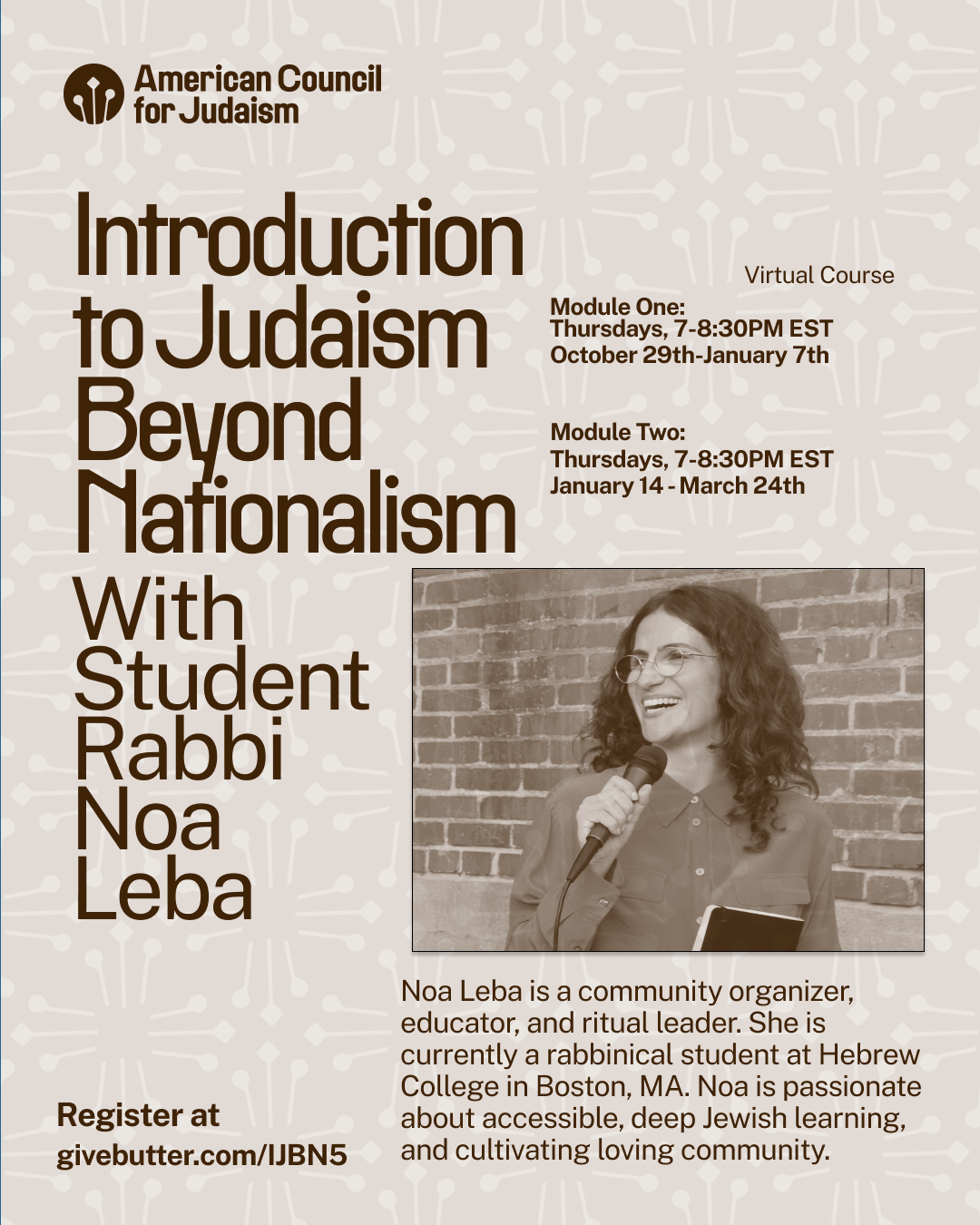
Introduction to Judaism Beyond Nationalism with Student Rabbi Noa Leba
Introduction to Judaism Beyond Nationalism is a broad-stroke survey of Jewish life, culture, belief and non-belief, and the major ideas that have shaped Jews and Judaism across time. The course offers participants a grounding in the practices, philosophies, and expressions of Jewish life from the ancient world to the present.
Learn More

- Education Series
Parshanut: An Intro to Jewish Commentary
Parshanut: An Intro to Jewish Commentary
Wednesdays at 6:00-7:30 PM EST October 21st - November 25th
This six session class will introduce students to the world of Jewish Torah commentary, known as parshanut. We'll study the weekly Torah portion with some of the most foundational commentators, exploring the approaches of these medieval and early modern rabbis to interpreting Tanakh.
Learn More
- Education Series
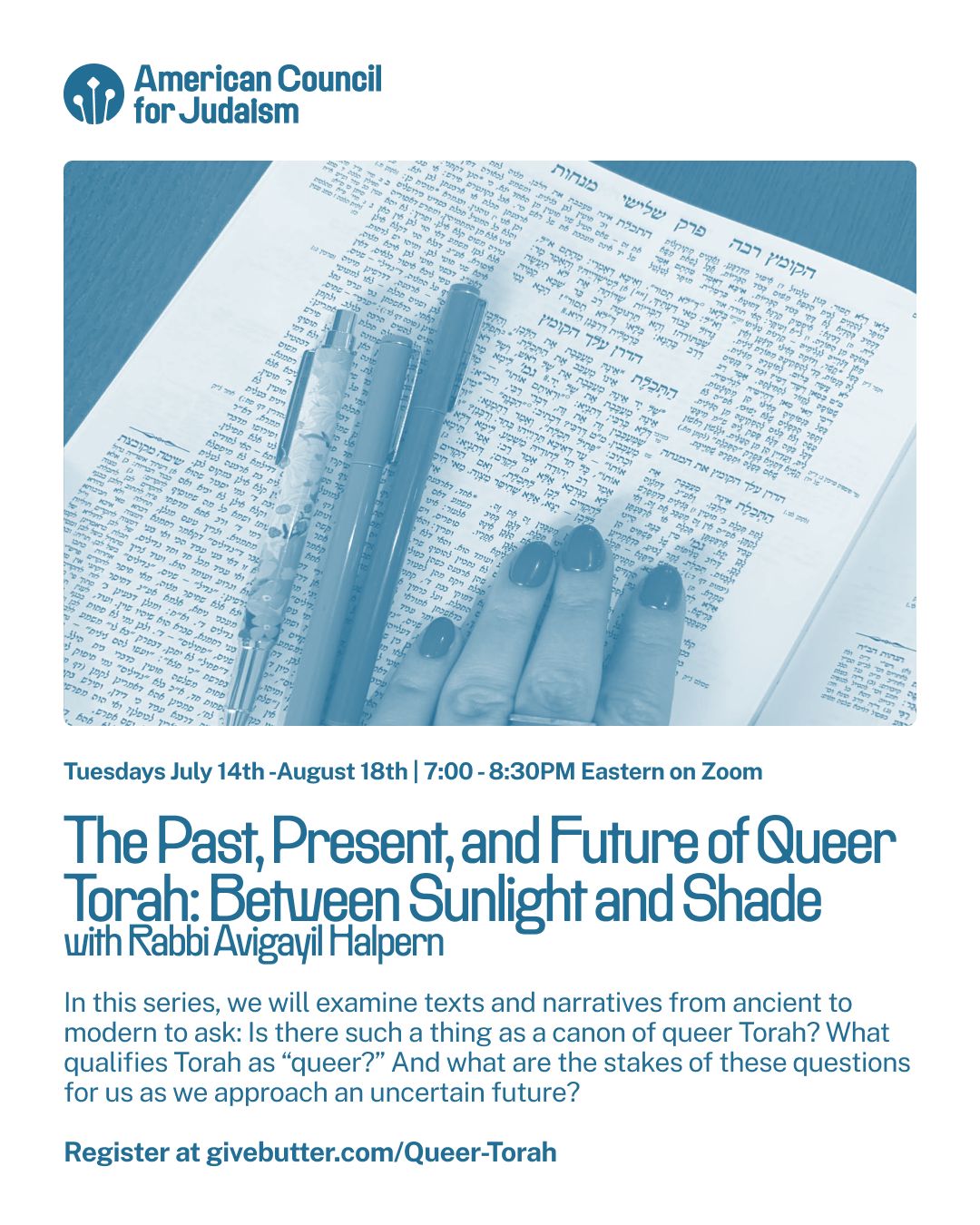
The Past, Present, and Future of Queer Torah: Between Sunlight and Shade With Rabbi Avigayil Halpern
This class takes its name from the Rabbinic sage Rabbi Yochanan, who is often read as queer – his beauty is described as that of a silver goblet filled with pomegranate seeds and crowned with roses, set between sun and shade. It is in the beauty of that middle space that queer Torah emerges. In this series, we will examine texts and narratives from ancient to modern to ask: Is there such a thing as a canon of queer Torah? What qualifies Torah as “queer?” And what are the stakes of these questions for us as we approach an uncertain future?
Learn More