What We Do
Judaism Beyond Nationalism
The ACJ offers Jewish education, intercommunal connections, and religious guidance beyond nationalism—free from the Zionist idea of Judaism as a nationality or the elevation of one nation above others. We support individuals, locally rooted groups, and synagogues in cultivating Jewish ritual spaces and practices grounded in justice, solidarity, and humility.
Featured Programming
- Education Series
- Event
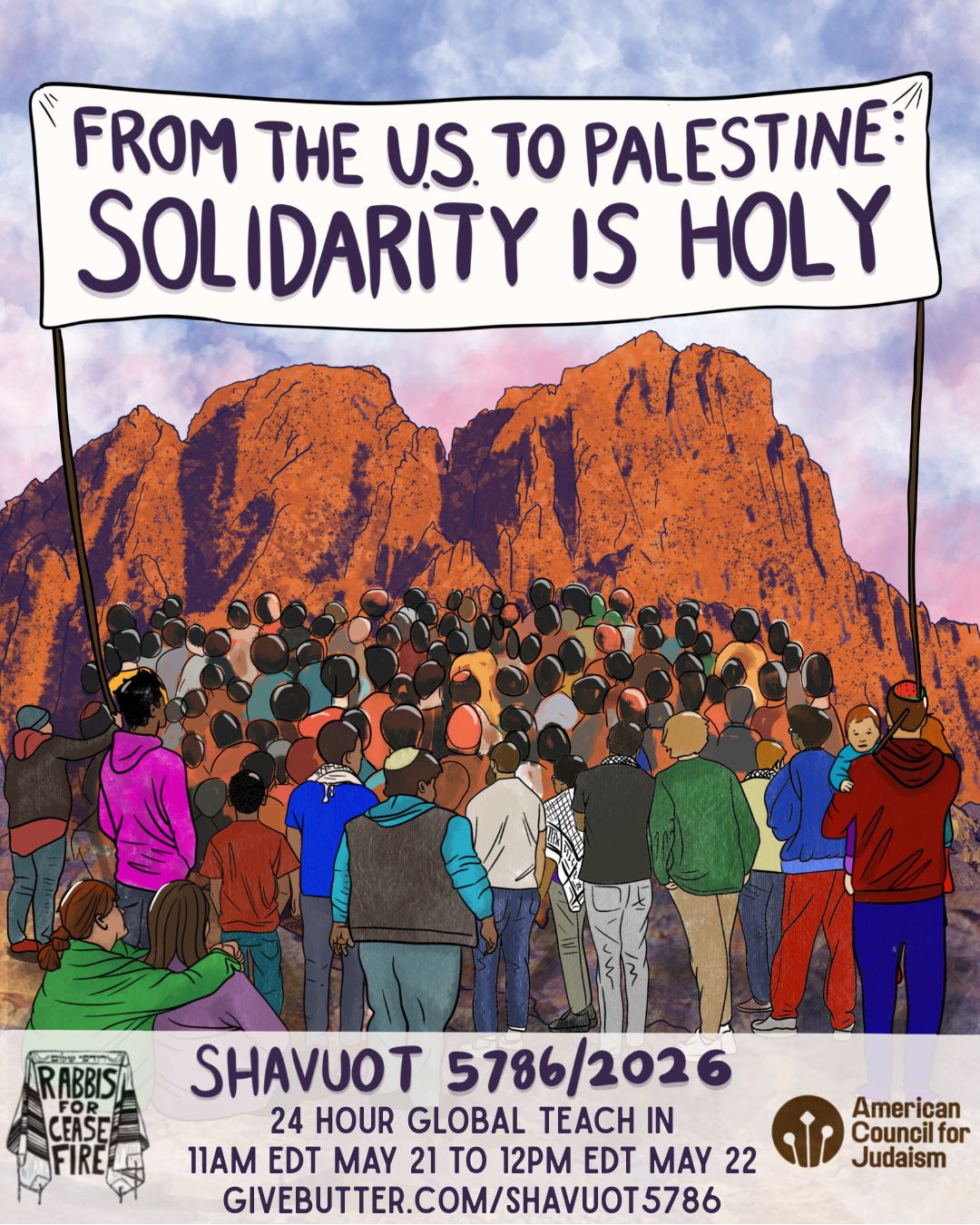
Global Shavuot Teach-in "From the US to Palestine: Solidarity is Holy"
On May 21st-22nd, the American Council for Judaism and Rabbis for Ceasefire will be hosting our third annual Global Shavuot Teach-in
Under the theme “From the U.S. to Palestine: Solidarity is Holy” we will demonstrate global Jewish solidarity with Palestine, deepen relationships across continents, and develop shared analyses, songs, interpretations of texts and beyond that guide our way to liberation.
This teach-in will be wide ranging including short films and discussions, traditional Jewish text studies, skill shares, song shares, history lessons, political discussions, art making workshops and beyond!
We look forward to seeing you there!
Learn More
- Event
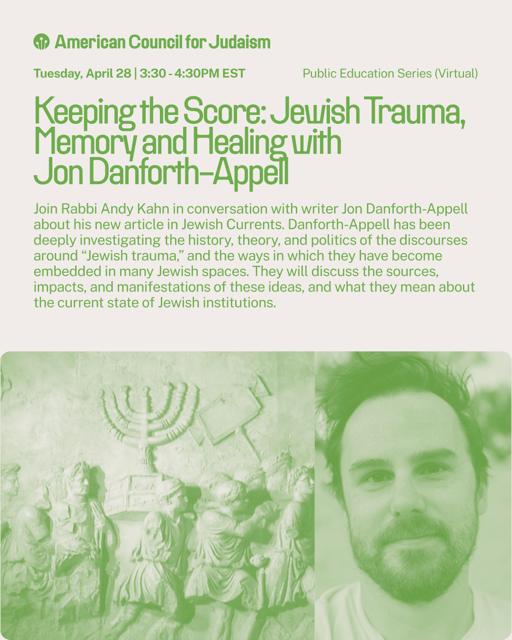
Keeping the Score: Jewish Trauma, Memory, and Healing with Jon Danforth-Appell
What if the dominant progressive Jewish explanation for Zionist attachment, that our bodies carry the accumulated trauma of generations, is itself a kind of myth?
In his just-published essay for @jewishcurrents, "Does the Jewish Body Keep the Score?", writer Jon Danforth-Appell traces how the language of embodied, intergenerational trauma has come to saturate Jewish organizing spaces over the past decade. He argues that this framework treats Zionism, a political project, as a pathology, and in the process flattens a wildly diverse community into a single wounded body, relieving us of agency in the process.
Join Rabbi Andy Kahn in conversation with Jon on Tuesday, April 28 at 3:30 PM EST for a public education conversation exploring the history, theory, and politics of "Jewish trauma" as a concept. We'll talk about where these ideas come from, what they do inside our institutions, and what becomes possible when we accept agency as creators of Judaism.
Learn More
- Education Series
- Streaming
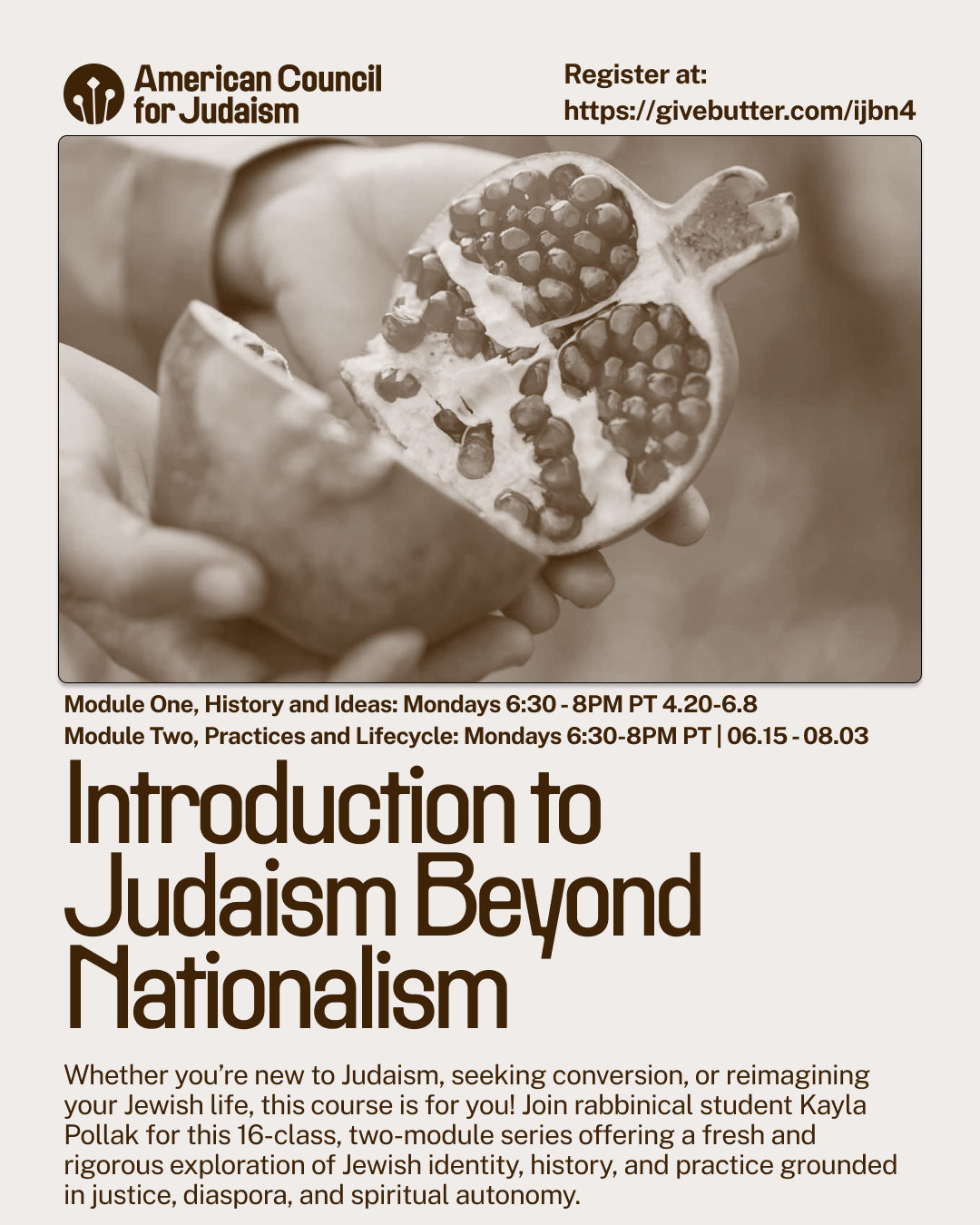
Introduction to Judaism Beyond Nationalism Cohort 4
What is a Jew? What is Judaism? And what does Jewish life look like when it's grounded in ethics, history, and practice rather than nationalism?
Whether you're Jewish, Jew-ish, exploring conversion, or simply curious, you're invited into this space.
Introduction to Judaism Beyond Nationalism is a 16-week survey course broken up into two modules, covering Jewish history, belief, practice, lifecycle, philosophy, and culture from the ancient world to the present.
We'll ask hard questions, sit with complexity, and learn together.
Learn More
Iyar Shabbat Haggadah 5786
Rather than a single Kiddush, this haggadah offers four cups, each paired with a text and reflection prompts drawing on poetry, Talmud, midrash, and Hasidic teaching. The cups move through four themes: poetry and song, action and doing, ethical responsibility, and spiritual practice. You can use all four in a single evening, or one cup per Shabbat throughout the month.
This haggadah was created by the American Council for Judaism in collaboration with Rabbis for Ceasefire, and includes contributions from three writers whose Jewish commitments span administration, rabbinics, and mystical art.
Whether you gather with a havurah, a family, a few friends around a table, or for personal reflection, this haggadah offers a structure for Shabbat that is rooted in tradition and oriented toward the world we are working to build.
Learn More
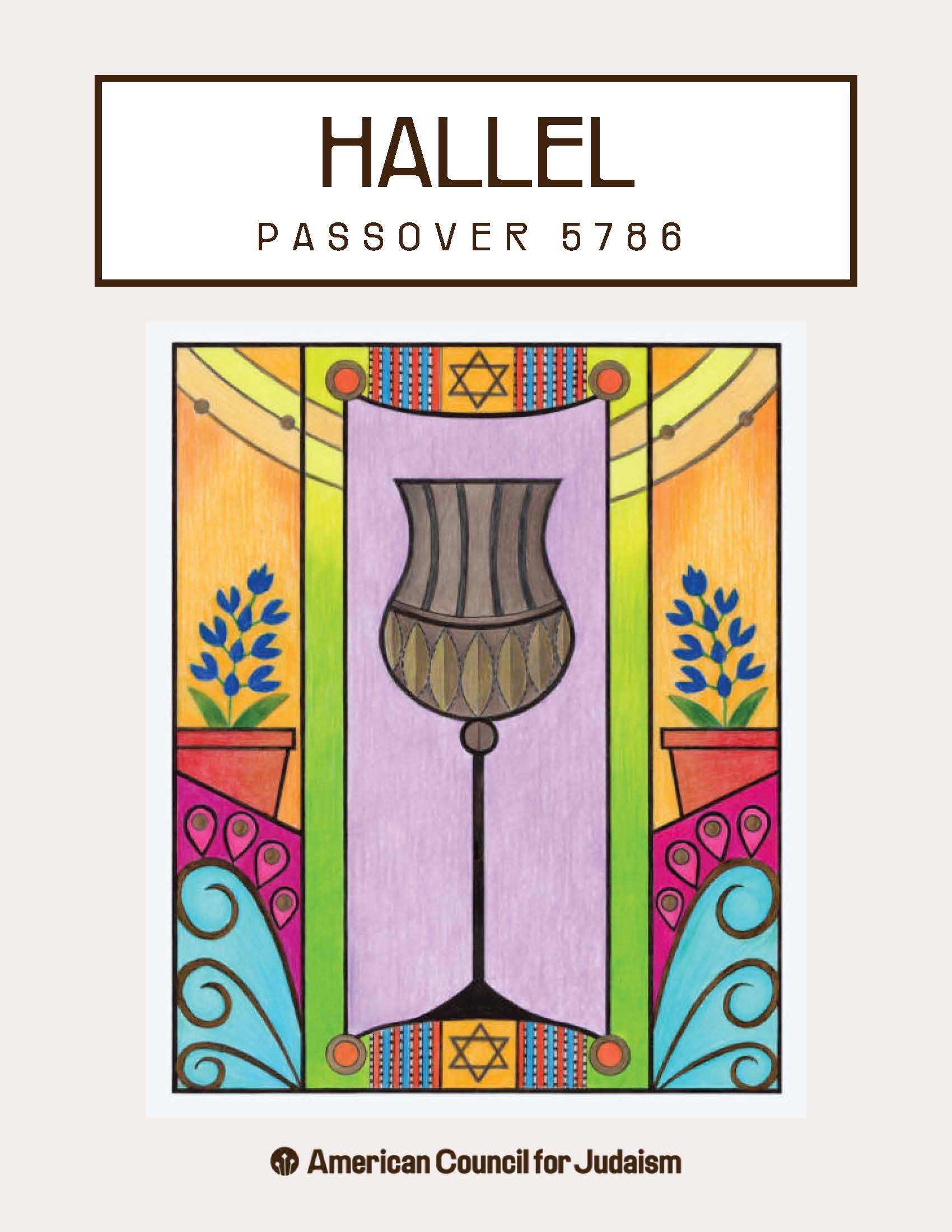
Our Passover Hallel Guide
Hallel is among the oldest sequences in Jewish liturgical life, and at many seder tables it passes by quickly or gets skipped past entirely. This year we're offering something to slow it down.
Our free to download Hallel guide pairs each of the six psalms with a new translation, a contemporary poem, and a discussion question for your table. Audio recordings by Cantor Laura Stein accompany each psalm.
Learn More

- Education Series
- Streaming
Across Generations: Steve Naman and Sam Panken
Join us on Thursday, March 19th at 6:00 PM Eastern for a wide-ranging conversation between two people who have devoted themselves to the American Council for Judaism, one who shaped its modern history, and one who is helping write its next chapter.
Learn More

- Lecture Series
- Streaming
The Cultures of the American Jewish Left with Benjamin Balthaser and Dania Rajendra
Join ACJ executive director Andy Kahn, Open Society fellow Dania Rajendra, and professor of multiethnic US literature at Indiana University, Benjamin Balthaser, for a timely conversation on Jewish radical history, anti-Zionism, and the roots of today’s Jewish uprising for Palestinian liberation.
Learn More
- Event
- Midtown, NYC
- Streaming
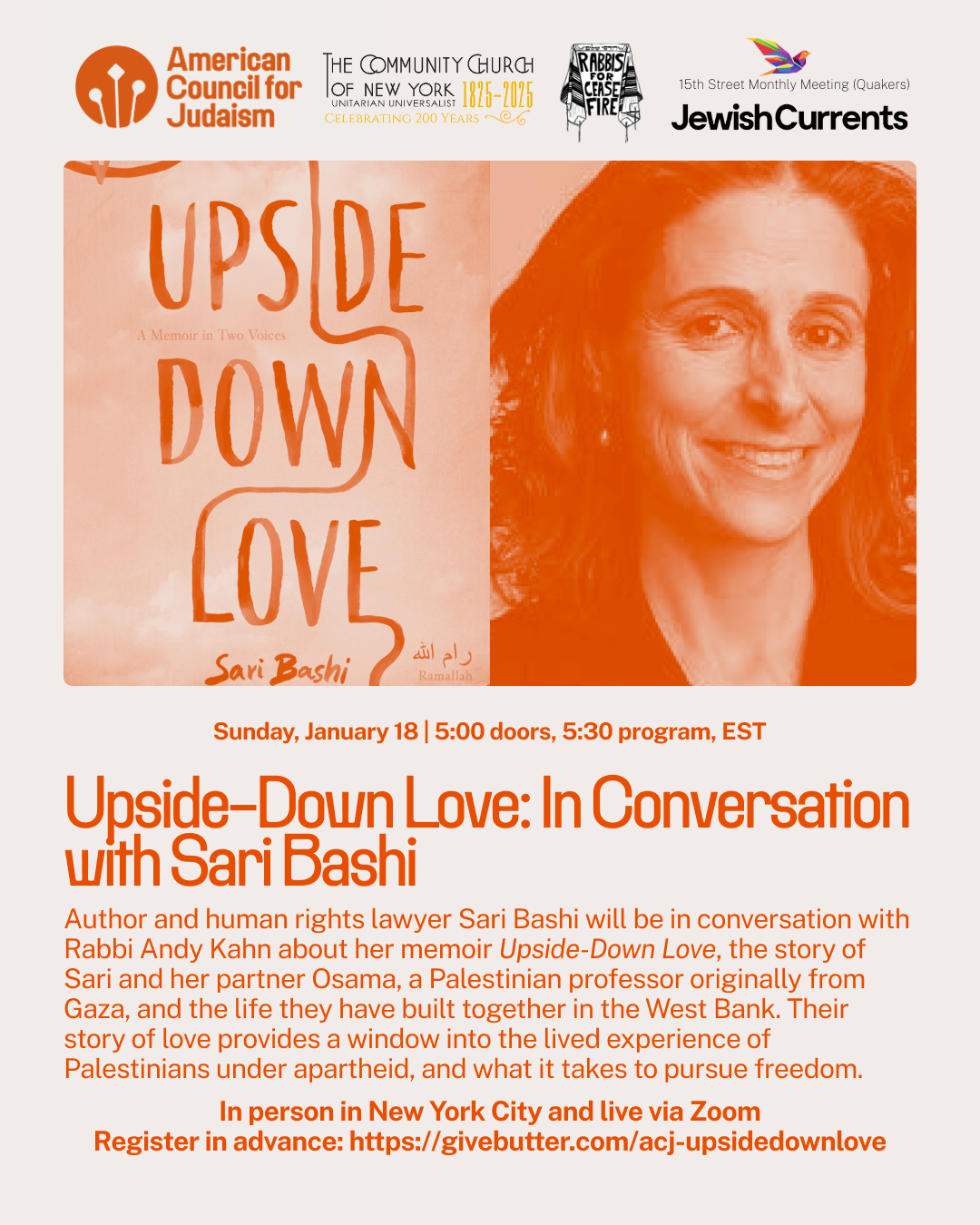
Upside-Down Love: A Conversation with Sari Bashi
The American Council for Judaism, Community Church of New York, Jewish Currents, Rabbis for Ceasefire and 15th Street Monthly Meeting (Quakers), invite you to an evening with author and human rights lawyer Sari Bashi, in conversation with Rabbi Andy Kahn, discussing her memoir Upside-Down Love.
Upside-Down Love tells the story of Sari and her partner Osama, a Palestinian professor originally from Gaza, and the life they have built together in the West Bank under the apartheid conditions of restricted movement, legal uncertainty, and enforced separation. The memoir speaks to the unique circumstances of this specific moment in history, while also illustrating a timeless truth: Love will triumph over bigotry and destruction.
Together, Sari Bashi and Rabbi Kahn will explore how personal story, law, and Jewish ethical frameworks can illuminate paths toward a more humane future.
Learn More
- Event
- Streaming
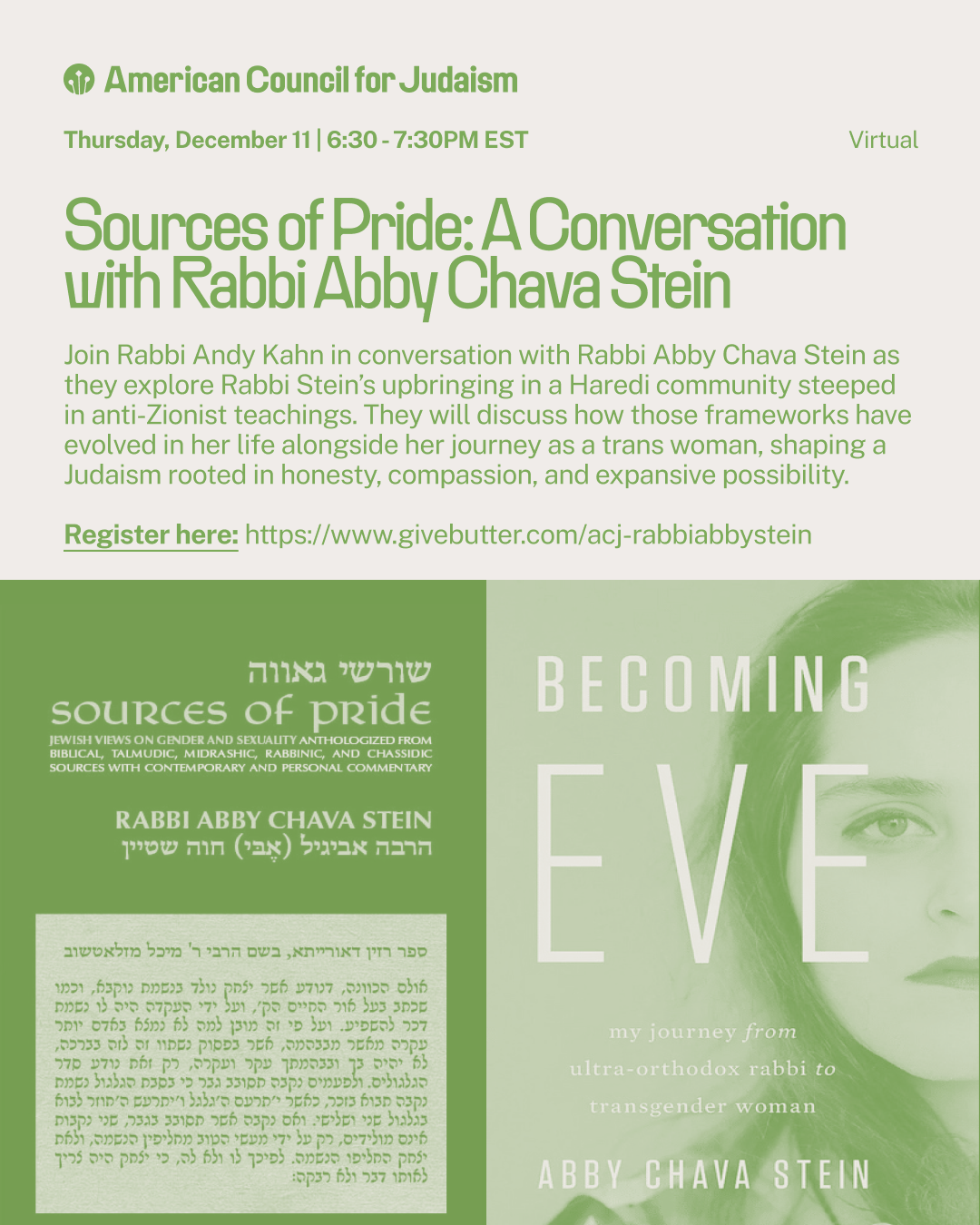
Sources of Pride: A Conversation with Rabbi Abby Stein
Join Rabbi Andy Kahn and Rabbi Abby Chava Stein for a powerful conversation about the evolving edges of Jewish life today. Abby reflects on growing up in a Haredi community shaped by anti-Zionist teachings, how those ideas have shifted over time, and how her journey as a trans woman has helped her craft a Judaism rooted in truth, dignity, and expansive possibility.
Learn More

- Education Series
- Streaming
From Trauma to Transformation: A Conversation with Rabbi Tirzah Firestone
Join Rabbi Andrue Kahn for a conversation with Rabbi Tirzah Firestone, acclaimed Jungian psychotherapist, teacher of Jewish renewal, and author of Wounds into Wisdom: Healing Intergenerational Jewish Trauma. Drawing on Jewish tradition, psychology, and case studies from across the globe, Rabbi Firestone offers seven principles for transforming inherited pain into resilience and moral clarity. Together, we'll explore how Jewish wisdom can guide us through grief, hope, and collective transformation in this season of reflection.
Learn More

- Education Series
- Streaming
Dismantling Antisemitism with Kohenet Shoshana Brown
Join Rabbi Andy Kahn and Kohenet Shoshana Brown for a powerful conversation about how accusations of antisemitism are increasingly weaponized to silence dissent, divide communities, and align Jewish identity with far-right agendas. We'll explore how to dismantle antisemitism through liberatory, non-punitive practices grounded in restorative justice, solidarity, and collective healing.
Learn More
- Education Series
- Streaming
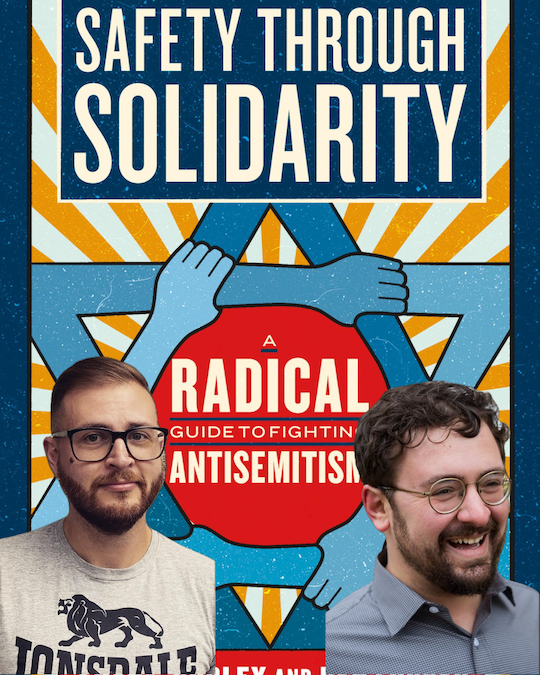
Beyond Fear: Combatting Antisemitism with Shane Burley and Ben Lorber
Rabbi Andy Kahn will be joined by Ben Lorber and Shane Burley to discuss their recent book, Safety Through Solidarity. The discussion will highlight approaches of shared responsibility across difference in the fight for justice and safety for all people as as the most effective form of combatting antisemitism.
Learn More
- Education Series
- Streaming
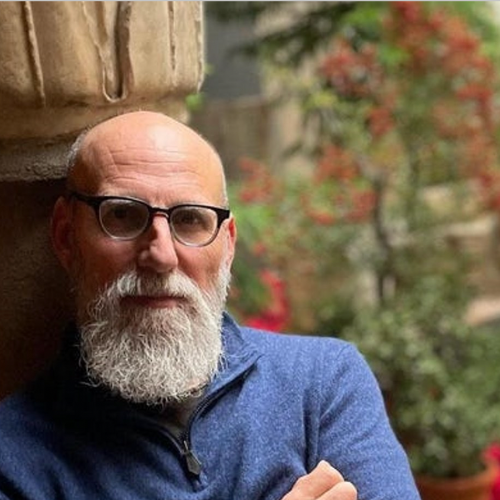
People, Faith, Nation: Exploring Judaism’s Many Identities with Professor Rabbi Shaul Magid
Join Rabbi Andy Kahn in conversation with Professor Rabbi Shaul Magid for a deep dive into the possibilities of post-ethnic Judaism in America. Together, they’ll explore how shifting tides in Jewish identity intersect with the growing crisis of Zionism, and what this moment might mean for reimagining Jewish life beyond nationalism.
Learn More
Featured Articles

Vayeitzei: The Fear That Won’t Look Away
Jacob’s story shows that deception ends only when he allows himself to feel the full weight of pachad, the fear that brings truth into view. This week's Torah portion calls us to adopt that same moral discipline in a time when misinformation and state violence rely on our willingness to look away.
Read More

- News
Jews differ on both Zionism and Mamdani
This essay argues that American Jews face a defining choice between a Judaism bound to nationalism and one rooted in ethical universalism and democratic freedom. Reclaiming Judaism’s tradition of debate and conscience, it calls for building diverse, democratic Jewish futures grounded in human dignity and collective liberation.
Read More

- History Series
What is “The Jewish People?”
Today, it is our duty to reach back to the sources of our traditions to seek out who they were built for—a search for who we are today in line with the question of 'who have we been'?
Read More
- Special Interest Report
American Jewish Groups Show Division Over Israel’s Role in Gaza
Read More
- Issues
For Whom Does The "Jewish Establishment" Really Speak?
Read More

We believe that the present tragic experiences of mankind abundantly demonstrate that no single people or group can hope to live in freedom and security when their neighbors are in the grip of evil forces either as perpetrators or sufferers. We hold therefore, that the solution of the social, economic and political problems of one people are inextricably bound up with those of others.
ACJ in the news
-
01
Rabbi Andy Kahn on Flashpoints
Executive Director Rabbi Andy Kahn joined Flashpoints to discuss the Mamdani candidacy and the running debate in the American Jewish community about Zionism and Israel.
-
02
Jews differ on both Zionism and Mamdani
This essay argues that American Jews face a defining choice between a Judaism bound to nationalism and one rooted in ethical universalism and democratic freedom. Tracing its lineage to the early Reform movement, the American Council for Judaism reaffirms that Jewish life does not depend on a state but on Torah’s core teaching that every person is created b’tzelem Elohim—in the image of God. Rabbi Andrue Kahn denounces the recent “Rabbinic Call” attacking Zohran Mamdani as an authoritarian attempt to equate Jewish identity with loyalty to Israel and to silence dissent within Jewish and Democratic politics. Most Jews, he contends, reject such conflation and oppose Israel’s assault on Gaza, seeing Jewish safety in solidarity and justice at home, not in nationalism abroad. Reclaiming Judaism’s tradition of debate and conscience, Kahn calls for building diverse, democratic Jewish futures grounded in human dignity and collective liberation.
-
03
During the High Holidays This Year, We Are Reaching Toward an Abolition Judaism
This essay critiques the weaponization of “Judeo-Christian values” as a tool of domination linking Zionism, policing, and carceral logics across the U.S. and Israel, arguing that true Jewish safety and ethics lie instead in solidarity and abolition. It traces how mainstream Jewish institutions, trained in nationalist theology, have replaced Judaism’s vision of olam habah—the World to Come—with an ethnonationalist project centered on Israel, rendering Jewish ethical wisdom inaccessible to abolitionist movements. Drawing on thinkers like Ruth Wilson Gilmore, Mariam Kaba, and Maimonides, the authors frame Abolition Judaism as a spiritual-political project: recoupling Jewish culture with the struggle to build a restructured, liberated society. Using the Book of Jonah as parable, they call Jews to reject punitive “righteousness,” practice teshuvah (repentance) as collective transformation, and move beyond nationalism toward a world of justice, freedom, and interdependence.
-
04
Rosh Hashana helps us envision a Judaism beyond nationalism
As debates over antisemitism, Zionism, and Judaism intensify, this piece argues that Rosh Hashana’s universal vision offers a corrective to the ethnonationalism that has come to dominate Jewish identity. The essay traces how early 20th-century thinkers like Louis Brandeis and Mordecai Kaplan redefined Judaism through the lens of “Jewish peoplehood,” merging chosenness with nationalism and tying Jewish belonging to the state of Israel. In contrast, Jewish history shows a plural, diasporic tradition grounded in covenant and ethical responsibility, not national unity. Drawing on thinkers like Maimonides, Judith Plaskow, and Judith Butler, the essay calls for reclaiming Judaism as a universal, justice-oriented practice of interdependence that thrives among diverse communities, dedicated to the flourishing of all life.